UX Content
  • Case Studies
  • UX Bites
  • Cheatsheets
  • Psychology
BFM+
  • Instant Feedback
  • MCP
  • Figma Plugin
  • Tiers & pricing
  • Free newsletter
  • Log in
Other
  • Archive
  • About
  • Help
  • Changelog
Services
UX audits

A complete audit of your user experience, delivered in a format that you can't ignore.

Book an audit

Built for Mars Ltd is a company registered in England and Wales (Company No. 12731987).

Account
  • Log inAccess your library and activities
  • SubscribeUnlock all features and access to the library
Learn from the best companies in the world

A library of content that even non-designers find interesting.

Subscribe todaySubscribe today
Structured learning
  • UX BootcampEnroll in a 5-week bootcamp
  • PathwaysCreate custom learning Pathways to work towards any goal, industry or topic
  • CollectionsBrowse Case Studies by key topics
  • QuizzesTest your knowledge
Explore the library
  • Case StudiesSlideshows that are packed with research
  • UX BitesReal examples of design magic
  • CheatsheetsQuickly level up in a particular area
  • Product PsychologyLearn the essentials
  • NewsletterGet research straight to your inbox
  • CompaniesBrowse by company
Learn from the best companies in the world

A library of content that even non-designers find interesting.

Subscribe todaySubscribe today
Tools to help you
  • AI InsightsUpload screenshots of your design, and get instant feedback from our AI
  • MCPAccess the entire library from your favourite agent
  • Figma pluginAccess our AI tools, and our entire library, directly from Figma
One-to-one help
  • UX AuditsThe fast-track for growth
Includes tools that help you ship better products

Learning never stops, but sometimes you need a little more.

Subscribe todaySubscribe today
Log inSubscribe today
Home
UX Glossary
Cognitive Dissonance

😮‍💨

Cognitive Dissonance

The internal discomfort of holding conflicting opinions.

Featured in 14 UX Bites

Similar psychology:

Hyperbolic Discounting
Fresh Start Effect
Confirmation Bias

Likely impacts:

Churn
Feature Usage
Habits
Discomfort & Frustration
Happiness & Enjoyment
Input Quality
Last updated: 23/09/2026

How to utilise this in your designs

You could experiment with opening the front camera when users break their own rules, so the cognitive dissonance of seeing themselves nudges them back on track.

UI shows intervention options: Breathing Exercise, Minimal Breathing, Follow the Dot, Black Screen, Rotate Phone, Mirror (highlighted). Mirror prompts: "Look in your own eyes..." Try button.
Example from
One Sec logo
One Sec

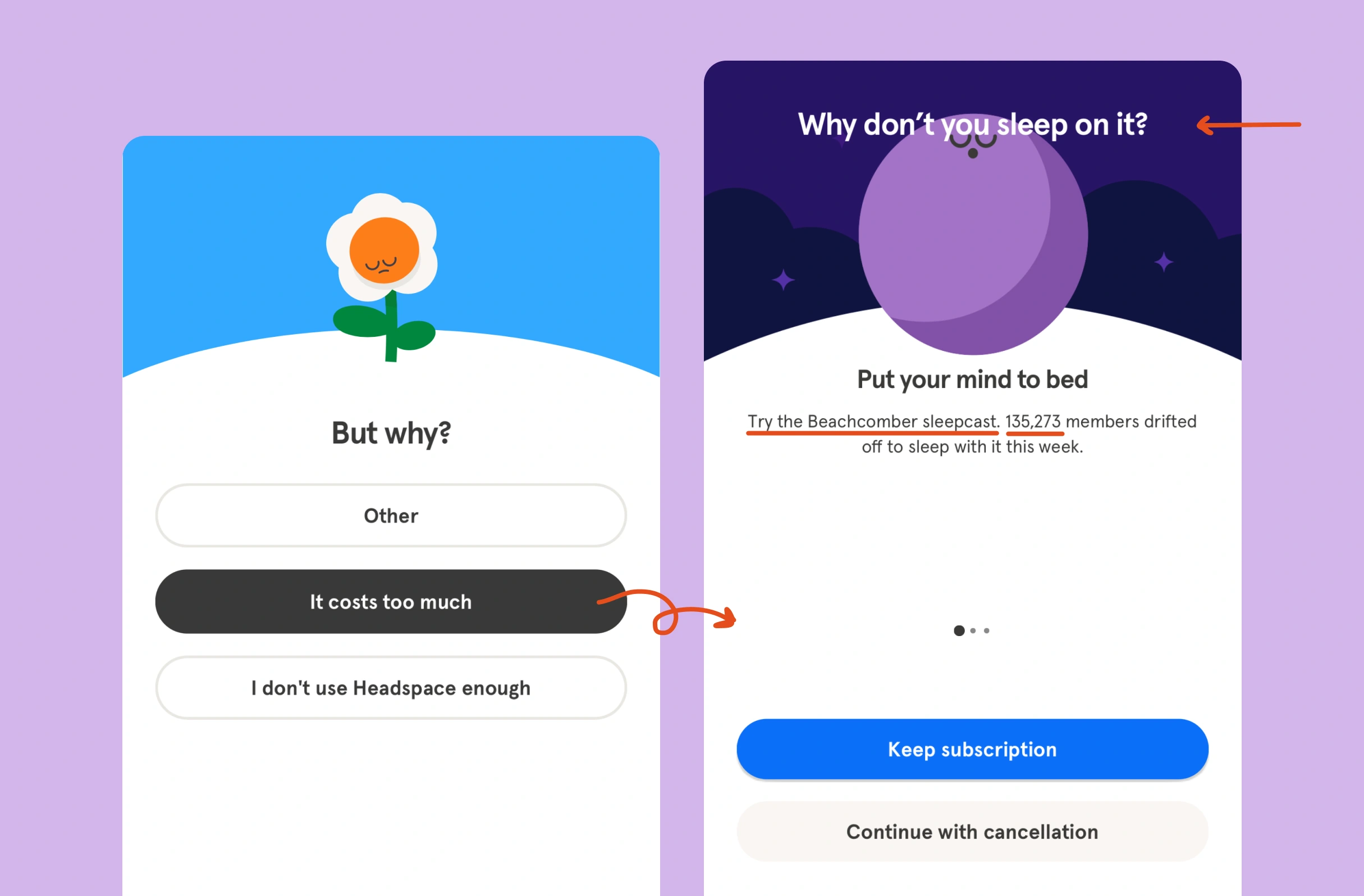
When users try to cancel, you could remind them of the goals they set, so leaving creates cognitive dissonance with the person they said they wanted to be.

Strava cancel subscription screen shows benefits: highlighted "twice as active" and "54% more personal records," plus Faster progress, Unlimited routes, Heart rate tracking features.
Example from
Strava logo
Strava

Try easing the guilt of missed sessions by offering to rearrange or skip them, reducing the cognitive dissonance that might otherwise push returning users away.

Workout app UI by Coach Ben encourages progress, offering two options: "Rearrange missed workouts" with 6 workouts this week or "Skip missed workouts" to keep the current plan. Red arrows highlight.
Example from
Runna logo
Runna

If users back out of a carbon offset pledge, you could offer to remind them later, easing the dissonance of saying no to something they believe in.

Carbon offset UI shows options to offset 100%, 120% (selected), or 200% of CO2 footprint with monthly costs; reminder toggle for follow-up in 7 days visible.
Example from
Klima logo
Klima

You could ask new users to slide to confirm their commitment during onboarding, so skipping their routine later feels dissonant with the promise they made.

Minimalist UI with a cream card on blue background; shows text: “I will follow my self-care routine for 21 days.”, a smiling tree icon, and a gray slide-to-confirm bar.
Example from
Evolve logo
Evolve

Possible impacts

If the cognitive dissonance of using your product feels too uncomfortable, e.g., guilt over binge-watching, users could quit, leading to an increase in churn.

As seen in:
Strava logo
Strava
Reframing your goals to reduce churn
Runna logo
Runna
Getting back on track

Users may avoid features that signal commitment, e.g., subscriptions, if they trigger cognitive dissonance, causing a drop in feature usage despite a clear benefit.

As seen in:
Sunlitt logo
Sunlitt
Showing off their 3D modeling
Flighty logo
Flighty
Pre-empting your return flight

It's possible users build habits more readily when a visible commitment makes skipping feel at odds with their self-image, as cognitive dissonance pushes follow-through.

As seen in:
One Sec logo
One Sec
Look at yourself, go on
Runna logo
Runna
Getting back on track

Cognitive dissonance, e.g., guilt over missed workouts or broken streaks, could increase frustration, unless users have a gentle way to reset without judgement.

As seen in:
Runna logo
Runna
Getting back on track

Reducing moments that trigger cognitive dissonance, e.g., guilt-inducing usage stats, may help users enjoy your product more and feel better using it.

As seen in:
Runna logo
Runna
Getting back on track

Users may exaggerate how often they'll do things to fit their self-image, lowering input quality in research and creating cognitive dissonance if reminded later.

As seen in:
Transit logo
Transit
Showing travel options in a timeline
Flighty logo
Flighty
Pre-empting your return flight
Peter Ramsey, Built for Mars Founder

Written by Peter Ramsey

Consultant to 100+ companies

Published: 24/08/2023